News & Insights

Pride at McGill and Partners

The insurance industry hasn’t always been recognised for having a diverse and inclusive workforce, especially when it comes to members of the LGBTQ+ community.

As a new broker, set to do things differently, McGill and Partners want to be a catalyst for positive change, addressing this issue as a vocal ally in the sector.

We’re creating a safe and inclusive environment and we want all our colleagues to feel confident bringing their whole identity to work. The most important asset in our firm is our people and we’re committed to empowering everyone to achieve their full potential, regardless of their sexuality or gender identity.

We’re also joining Link – the LGBTQ+ Insurance Network – on their mission to make the insurance industry the employer of choice for the LGBTQ+ community, highlighting needs and issues and raising money for LGBTQ+ charities. We’re delighted to be sponsoring this year’s Link Insurance Pride 2021.

Celebrating Pride 2021

Diversity is critical for any strong team, and we’re taking every opportunity to be supportive allies of the LGBTQ+ community. To celebrate Pride month, we’re hosting unique events for our clients and colleagues to highlight the invaluable contributions of LGBTQ+ people to society:

Equality in sport: A conversation with Anita Asante

3rd June, 4.30-5.30pm BST

Anita Asante is the former England football defender and 2012 GB Olympian with 71 international caps. Anita is both a sportsperson and seasoned academic, using her voice to advocate for minority groups as an Ambassador for Show Racism the Red Card and Amnesty International UK.

We invited Anita to talk about leadership, the importance of diversity to high performing teams, and challenging perceptions.

LGBTQ+ arts: A conversation with Clare Barlow

June 30th, 4:30-5.30pm BST

Clare Barlow is the curator of the Tate’s acclaimed exhibition: Queer British Art 1861-1967.

Clare will be talking about how the LGBTQ+ community found itself, found each other and fought for their freedoms in the years before decriminalization – despite setbacks, the queer past is ultimately a story of self-discovery, community and liberation.
Diversity and Inclusion at McGill and Partners

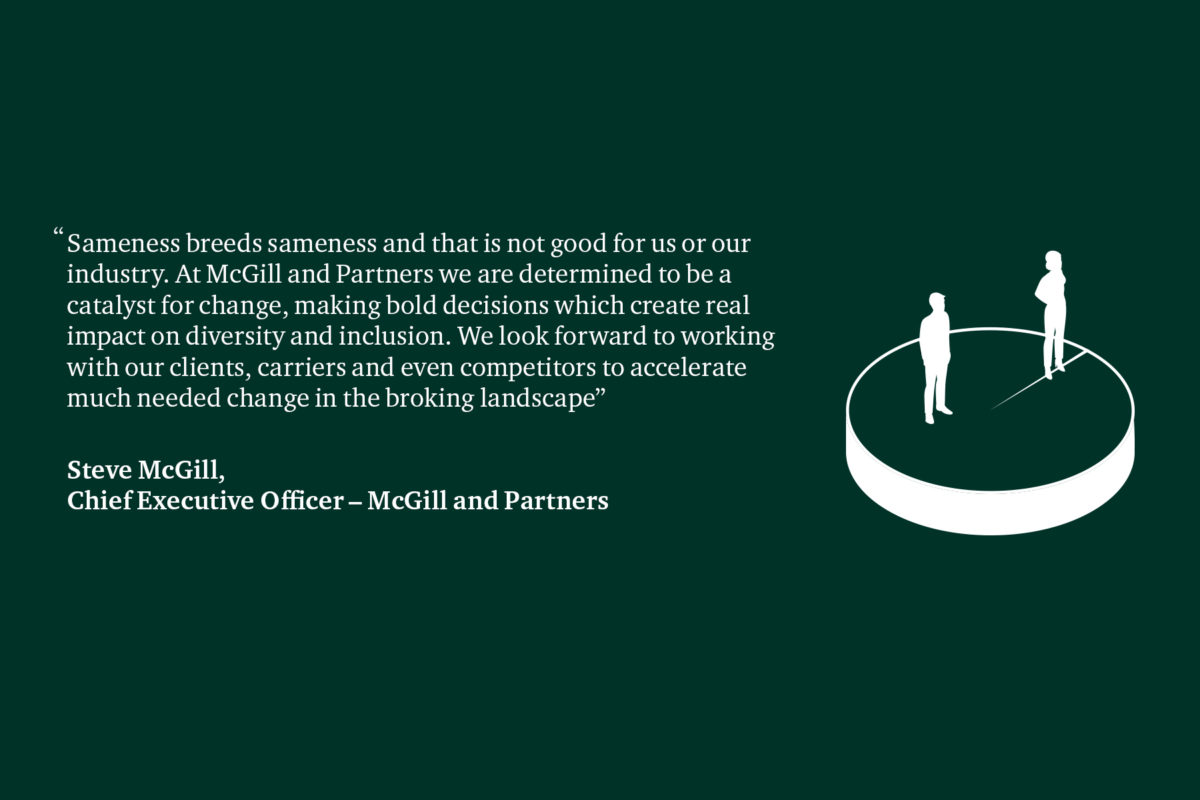
Whilst there are some clear examples of success, overall the (re)insurance industry has failed in its attempt to attract and retain a diverse talent pool at all levels. 

As an entrepreneurial new business, we are determined to change this – not for change’s sake but because we believe that a diverse and engaged colleague base with fresh perspectives is crucial to help us deliver innovative solutions for our clients.

We’re proud to be building a business that attracts and retains the most professional, creative minds in (re)insurance broking and inclusivity is key to our ambition.

No more empty words, let the numbers speak.

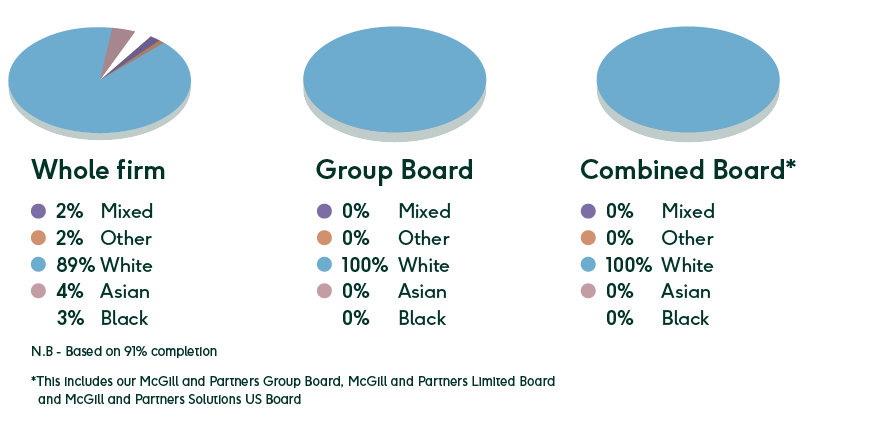
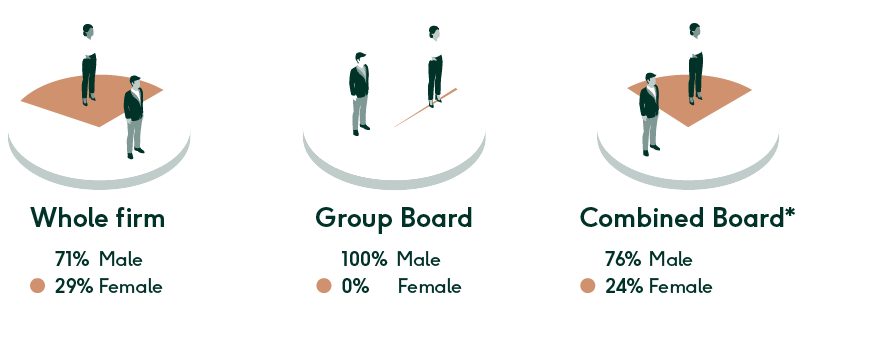
Our diversity statistics

Paying lip service to diversity changes nothing – to show our commitment we will be completely transparent and publicise our diversity statistics.

They don’t look good. We intend to do better.

This data is based on our colleague base as at 31st December 2020. We will update these statistics on an annual basis and look forward to demonstrating significant improvements over the next few years and beyond. We have set clear internal metrics on where we want our diversity mix to be.

1. Gender

2. Ethnicity

3. Sexual Orientation

4. Social Mobility

We also looked at social mobility and the social-economic background of our colleagues. Only 5% of our colleagues were entitled to free school meals. Supporting social mobility is one of our firm’s inclusion priorities and we want to attract the best talent, regardless of their background.  Our social mobility statistics have helped us shape our approach to the way we recruit. We’re focusing our social mobility efforts on entry level/2nd job roles and we will work hard to ensure future work placements and apprenticeship programmes are totally inclusive.

Our key initiatives

We have introduced a number of initiatives to improve our diversity and inclusion at McGill and Partners for 2021 and beyond:

1. Flexible working structures

We have established a ‘Contract of Trust’ with all our colleagues which allows us to apply leading-edge practice with regards to maternity/paternity leave as well as fully flexible working hours and holidays without set limits.

2. Executive leadership bonus risk

Our Exec team have agreed to put 10% of their individual bonus at risk on an annual basis which will be dependent on the improvement of our annual company diversity stats. This demonstrates that we intend to profoundly improve our stats year-on-year. 

3.Being bold in recruitment

We have introduced a number of core frameworks for our recruitment process which include committing to a diverse shortlist for all vacancies as well as mandating a diverse interview ‘panel’ for every role.

4. Introduction of Colleague Resource Groups (CRGs)

We have now established 3 Colleague Resource Groups across the firm: Pride at McGill, EDGE (Ethnically Diverse Group of Employees) at McGill and Women at McGill. These groups will help to foster awareness, respect and inclusion and promote the causes of the diverse groups they represent.

5. Partnering with purpose

We have partnered with The Brokerage to launch our Apprenticeship programme which will begin in Q4 2021. We will continue to partner with other firms to support our commitment to Diversity and Inclusion to bring in diverse talent to McGill and Partners and support the broader community.

We acknowledge we have much more work to do. Every colleague at McGill and Partners is expected to do their part in ensuring we build a truly diverse and inclusive business. Each colleague will take personal responsibility for creating change hire by hire, month by month, increment by increment.  We are making inclusivity personal. 

If you would like to explore opportunities to work at McGill and Partners, please apply here.

How do you discover sizeable new capacity at speed in a hard market? Ask Steve.

INEOS is a company that was contemplating significant amounts of self-insured risk because they were running out of options at their renewal. The clock was ticking. Could McGill and Partners achieve the almost-impossible; find in excess of $800 million of competitive insurance capacity in a hard market, shaken by Covid-19.

Client case study: INEOS

INEOS is a company with complex risk requirements which was seeking competitive insurance capacity in a hard market, shaken by Covid-19. Could McGill and Partners rise to the challenge by finding the capacity INEOS required, on budget and at pace?

A traditional approach to this placement was simply never going to cut it. What INEOS needed most was a truly outside-the-box perspective to reflect the new state of the market.

McGill and Partners lent their expertise, agility and, most importantly, our CEO’s willingness to roll up his sleeves and get on the phone, finding INEOS their full coverage, fast.

“McGill and Partners’ approach to us was definitely a case of serendipity. We are an agile company and a very entrepreneurial organisation and we like working with like-minded people. The McGill and Partners’ team brought creative and fresh thinking.”

Paul McDonald, Group Risk and Insurance Director,
INEOS Group Holdings

The bolder your ambition, the better we become

If you would like more information, please contact:

How do you cut a gold miner’s premium increase by millions, while improving cover and capacity? Keep on digging.

In the midst of a perilously hard market, Barrick Gold, the world’s second largest mining company, was facing a panic-inducing premium increase of 20% on their insurance.

Client case study: Barrick Gold

In the midst of a perilously hard market, Barrick Gold, the world’s second largest mining company, was primed to expect a significant premium rate increase on their insurance.

Luckily for them, they then appointed McGill and Partners, a broker with tenacity, especially when it comes to negotiating in a hard market. We combined a bold, proactive approach with our deep expertise, navigating market forces and introducing new insurers to provide competitive tension and ultimately to find a better solution for the client.

All in all, by working in collaboration with carriers, we lowered Barrick Gold’s premium increase substantially, saving them millions. We even enhanced their coverage so that more risks were taken care of. And all this against a backdrop where business interruption values were influenced by a year on year gold price increase of greater than 40%.

“Our trusted McGill and Partners team lived up to our high expectations through total focus, innovative broking and commitment to achieve an optimal result for the Barrick Gold Property programme.

Ashleigh Lawson, Senior VP, Business Assurance & Risk – Barrick Gold

The bolder your ambition, the better we become

If you would like more information, please contact:

Open Book with McGill and Partners: Maurice R. Greenberg, Chairman & CEO, Starr Insurance Companies

In this episode of Open Book, Steve McGill talks to Maurice R. Greenberg, Chairman & CEO of Starr Companies. They discuss his extraordinary early life, the key milestones in his career, his involvement in US/China relations as well as his views on leadership and the future of the industry.

In this episode of Open Book, Steve McGill talks to Maurice R. Greenberg, Chairman & CEO of Starr Companies. They discuss his extraordinary early life, the key milestones in his career, his involvement in US/China relations as well as his views on leadership and the future of the industry.
Open Book convenes leading thinkers and figures in the insurance industry to share insights, ideas and thoughts on key issues.

Special situations: using insurance solutions to facilitate distressed deals

Economic crisis will not be a new experience for most companies and financial sponsors. Recent downturns have presented their own unique challenges. The speed and shock of the COVID-19 crisis has allowed little time to plan.

Economic crisis will not be a new experience for most companies and financial sponsors. Recent downturns have presented their own unique challenges. The speed and shock of the COVID-19 crisis has allowed little time to plan. With countries accounting for over 50% of the world GDP in lockdown and house-hold brands already filing for administration, McGill and Partners has been analysing how the M&A environment will be different once deal activity resumes. 

While the crisis has, understandably, relegated M&A as an immediate priority, the volatility that has caused financial difficulties for many may soon present an upside for those looking to acquire or invest in companies that were previously off the market and now in need of capital. Corporates looking to sell non-core assets to bolster cash reserves to weather the storm or indebted sellers looking to reduce debt burdens present some of the many attractive opportunities for buyers / investors in this downturn. 

At McGill and Partners, we have been advising clients on using warranty and indemnity insurance to de-risk liabilities acquired when buying or investing in distressed situations. There are many characteristics of a distressed sale process that impose limitations or present challenges; careful thought and planning are required to navigate them. Here are some of the considerations you may wish to give thought to if you are looking to obtain M&A insurance protection for your distressed transaction. 

Insurance solutions using synthetic warranties 

While a buyer can take advantage of a distressed situation to acquire a high-quality target at a lower price, it will often not be afforded the same contractual protections that it might otherwise receive in a non-distressed, private M&A transaction. Sometimes it may not be possible for a buyer to negotiate a meaningful set of warranties because the seller is unwilling or unable to give them (for example, if the seller or management team’s equity is underwater or will result in negligible proceeds or perhaps, in the case of an insolvency practitioner, reflecting the limitations on his or her ability to disclose against the warranties because he or she has not been involved in the historic management of the business). In each case, the seller is looking to achieve a sale for the best possible price while limiting their liability. In such scenarios, it may be possible to structure an insurance solution where a synthetic set of warranties is included within a W&I insurance policy that would give the buyer protection if a warranty is breached. The warranties are deemed to be synthetic as they are not given by the seller in the transaction documents but instead are negotiated between the buyer and the insurer and included solely in the W&I insurance policy. 

For these types of policies, careful consideration needs to be afforded to the drafting and breadth of the warranties given by the insurer. Unlike a typical private M&A process, a buyer’s access to management teams and the level of diligence they can practicably conduct may be significantly restricted in a distressed sale process. Accordingly, the suite of warranties an insurer would be willing to cover may be more limited to reflect the matters that could reasonably be the subject of diligence by a buyer and its advisers with minimal engagement from the seller or management. 

In addition to reviewing the diligence the buyer has already conducted, the insurer will prepare a targeted Q&A focussed around the scoping of the warranties in order to elicit information from the seller to give them comfort to provide cover. The collaboration between the buyer, seller / management and insurer during this broker-facilitated process is of importance in determining the breadth of warranty protection, as the insurer seeks to align the scoping of the warranties with the buyer’s due diligence and responses to its Q&A. Ensuring the insurer is comfortable with the quality of the diligence exercise and disclosure process is of particular importance as the insurer does not have a traditional right of subrogation against the seller in the event of fraudulent non-disclosure since the seller is not giving the warranties under the transaction documents. For these reasons, it is necessary to engage with the insurance workstream as early as possible to allow the insurer to provide direction on the buyer’s diligence scope to achieve a set of warranties that is sufficiently broad to suit the buyer’s aims. 

Valuation and loss recovery 

Maximising the proceeds from a sale is important irrespective of the nature of the sale, particularly where a seller urgently requires an injection of capital. Though for some distressed transactions, pressure from creditors, maturing debt and falling levels of liquidity (amongst other factors) might drive a sale that sees a trade-off between maximum return and speed of execution. Irrespective of whether the seller is willing to give warranties, or an insurer structures a synthetic policy, if warranty insurance protection is sought buyers should give particular attention to the target’s valuation and how this interacts with the quantification of loss that would be recoverable under the policy. 

As recently reaffirmed by the High Court,[1] the correct measure of damages when quantifying loss for a breach of warranty in the relevant transaction document is the diminution in the value of the purchased shares, such diminution calculated by reference to the actual value of the target deducted from its market value had the breached warranty been true. While the courts will often look to the purchase price to determine the “market” value,[2] if expert evidence supports the conclusion that the company was sold at an undervalue (or indeed an overvalue) then the court will take this into account when determining the fair market value of the company and, therefore, the diminution in the value of the shares arising from the breach of warranty. 

This approach was recently applied by the courts,[3] with the judge citing both the speed at which the sale was executed and the sellers’ desire to sell the company in the immediate future as factors contributing to their conclusion that the company was sold at an undervalue. It was also found that, had the sellers’ contractual cap on liability in the relevant transaction document not been limited to the purchase price, the total damages awarded would have been in excess of the purchase price. 

Buyers should carefully consider the policy drafting to ensure the loss they would be able to recover aligns with their expectations, having regard to the target’s valuation. This is of particular importance where distressed targets are being acquired for a nominal value and buyers will need to give thought to the valuation methodologies applied, as these are likely to form an important focus of an underwriter’s review. 

It is also common in distressed sales for management to be given equity in the new target structure, which sometimes may be disproportionately higher than a non-distressed transaction. Where the rolling management team acts as warrantors, insurers take caution that a valid claim against the policy may result in management indirectly benefiting from their own breach of warranty. Depending on the percentage equity the rolling management take in the target group, consideration should be given to the loss insurers are willing to indemnify both in terms of the proportion of loss and nature of the breach of warranty; for example, some insurers might only pay claims proportionate to the insured’s equity interest in the target group or may limit the portion that may be recovered for a fraudulent breach. 

Minority investments 

Businesses in financial difficulty looking for an injection of capital or those with healthy balance sheets looking for capital to be used to acquire struggling businesses to accelerate growth may present attractive opportunities for third-party investors to obtain a minority interest in companies at an attractive valuation or that might otherwise not have been seeking financial sponsorship. For these investments, minority investors may seek warranty protection from the target company or its management, but the reality of the commercial relationship between the investor and the warrantor(s) may make claiming against them impracticable (indeed, warrantors may cap their contractual liability at a nominal amount from the outset). Warranty and indemnity insurance is commonly used by investors in these scenarios to provide them with protection for a breach of the warranties they have been given. However, the practicalities of a minority investment will inform the structure of, and approach to, the insurance policy. 

Following a claim, insurers will typically require access to certain information in order to properly assess the merits or quantum of a claim or require the insured to take or omit to take certain actions (e.g. to mitigate losses). Similarly, insurers will expect, usually at their own expense, to be entitled to fully participate in the defence, negotiation and settlement of third-party claims and, in particular, require the insured not to settle or compromise any third-party claims without the insurer’s prior written consent. In each case, a material failure to comply with these policy requirements is likely to prejudice the insured’s rights of recovery. Policyholders need to ensure that the drafting of these provisions has regard to the minority investor’s influence and reflect the contractual rights (either to information or participation) that the minority investor has to facilitate the insurer’s involvement in the claim. 

As is commonplace in a warranty and indemnity insurance policy, insurers will waive all rights of subrogation against the warrantor save in the case of fraud. Dependent on the investment structure and level at which a minority investor invests, and assuming a target company gives the warranties, if the investor has a direct or indirect financial interest in that entity (e.g. because the vehicle through which the investment is made becomes the parent entity), the insurer’s subrogation rights need to be more closely considered. While the insurer agrees to indemnify the investor for an insured loss, if that loss arose from a warrantor’s fraudulent breach of warranty the insurer’s rights of subrogation could permit recovery of the loss amount from the warrantor. Thus, the investor’s financial interest in the warrantor would indirectly cause them to suffer a financial loss at a subsidiary level. Investors should make sure that insurers narrow their subrogation rights further to limit this application. 

The bolder your ambition, the better we become 

Combining true expertise with a fresh perspective to deliver market defining risk solutions, our experienced M&A team is committed to helping clients to navigate the current uncertainty and to capitalise on the opportunities presented. There are many other creative bespoke solutions our M&A team has developed to address deal issues, each tailored to the situation and the needs and objectives of the client.

If you would like more information on the solutions outlined, or to find out if we can use our expertise and creativity to help you to resolve any other deal issue, please contact: 

James Swan | james.swan@mcgillpartners.com 

_____

[1] Oversea-Chinese Banking Corp Ltd v ING Bank NV (2019). 
[2] See Triumph Controls UK Ltd & Anor v Primus International Holding Co & Ors (2019). 
[3] Cardamon Ltd v Macalister & Anor (2019). 

Open Book with McGill and Partners: John Neal – CEO, Lloyd’s of London

This is our first episode in our new series called ‘In Conversation with McGill and Partners’. In this episode, Steve McGill talks to John Neal, CEO of Lloyd’s of London to discuss the impact of Covid-19, the future of the insurance market and the recent announcement of the Aon’s planned acquisition of Willis.

This is our first episode in our new series called ‘In Conversation with McGill and Partners’. In this episode, Steve McGill talks to John Neal, CEO of Lloyd’s of London to discuss the impact of Covid-19, the future of the insurance market and the recent announcement of the Aon’s planned acquisition of Willis.

In Conversation with McGill and Partners convenes leading thinkers and figures in the insurance industry to share insights, ideas and thoughts on key issues.

Bespoke insurance solutions to navigate uncertainty and create opportunity

When undertaking a strategic sale or purchase, it is always wise to have the experts in each field beside you. In volatile and uncertain times, the need to have experienced, creative and dedicated advisors to help navigate the obstacles becomes even more critical

Navigating uncertainty 

When undertaking a strategic sale or purchase, it is always wise to have the experts in each field beside you. In volatile and uncertain times, the need to have experienced, creative and dedicated advisors to help navigate the obstacles becomes even more critical. Although there are some similarities to previous crises, COVID-19 presents many novel challenges that advisors need to be alert to and which require creative solutions. At McGill and Partners, our M&A team has been advising clients and helping them to navigate some of these challenges as underwriters adjust their approach in the current climate. 

Creating opportunity from uncertainty 

We have also been looking at how M&A insurance can be used to help create opportunity from the current uncertainty. While M&A plans may have been put on hold, many of our clients have found that now is a good time to think about the opportunities created by the crisis. There are many creative ways we develop bespoke insurance solutions to facilitate these opportunities, helping clients to transfer risks from their transactions to insurers. Here are some of the solutions you may wish to consider as you position yourself to take advantage of a change in the market:

Buying from a distressed seller 

Corporates looking to sell non-core assets to bolster cash reserves to weather the storm or indebted sellers looking to reduce debt burdens present opportunities for buyers. Sometimes these sellers will not be willing to give recourse for a breach of the warranties they are giving buyers. In other cases, buyers may not be willing to rely on the seller being in a financial position to pay a claim. Our M&A team has extensive experience working on transactions where there is no recourse to a seller or where management are not fully engaged in the sale process; these transactions are often conducted in compressed timetables and it is essential to consider the approach to disclosure and the scope of diligence that can reasonably be carried out when assessing the insurance options that might be available to provide buyers with protection. Careful consideration must also be given to a distressed asset’s valuation and how this affects a buyer’s losses and available recovery. 

Buying from an insolvency practitioner 

The acquisition of a company or business from an insolvency practitioner can often present an attractive opportunity but carries its own difficulties. Insolvency practitioners will seek to obtain the best price on a sale in the circumstances but will not be willing to incur personal liability, limiting the protection a buyer might be offered. It is possible to structure solutions that provide protection for the breach of a set of ‘synthetic’ warranties in situations in which the seller is not willing or able to give such warranties, affording the buyer greater certainty of the asset they are buying with the comfort of insurance capital to back the warranties. 

Acquiring a public company 

The equity markets have fallen significantly in recent months. Combined with the volatility in currency markets, many clients are scanning for opportunities to acquire public companies at a significant discount to the prevailing price just months ago. In many jurisdictions, the protection a buyer can obtain is influenced by the regulatory regime in force. We may be able structure a solution that gives a buyer protection:  

Where a sale process has been conducted, it may be possible to obtain insurance protection that gives greater certainty by insuring against the inaccuracy of information provided by the target. 

_Where there has been little or no disclosure from the target, it may be possible to structure a solution that provides protection for a synthetic set of core warranties covering the business of the target. 

Preparing a portfolio company for sale 

Naturally, many of our clients are turning to their portfolio companies and supporting them through these challenging times. In doing so, some are starting to consider preparing these companies for sale and addressing issues in those businesses that might inhibit a sale or for which buyers might discount the target’s valuation. Our experienced M&A team has worked with clients over the years to develop creative solutions to use insurance capital to optimise proceeds on a sale: 

_ Hard and soft staples are becoming increasingly common as sellers seek to take control of the insurance process to maximise its efficiency and present a sale package that gives buyers a high level of protection. Where sellers are using any delays due to the current environment to conduct vendor due diligence, we have found that hard staples can be a particularly effective way to facilitate the sale, maintain control of the process and deliver superior cover for bidders. 

_Our M&A team has structured contingent risk insurance solutions to isolate risks in portfolio companies that allow sellers to address issues before commencing a sale process and present buyers with a solution, giving comfort and avoiding costly price-chips, extensive negotiations or avoidable indemnities. 

Taking a minority stake 

As companies move to shore up their balance sheets, there will be opportunities to take equity positions in companies in exchange for minority stakes at attractive valuations. The warranties given to new investors can be insured to provide protection for the investment in the event of a breach, but it is important to structure the solution to ensure it is practicable, including that information an investor needs to make a claim reflects the information they will receive as an investor; that any involvement the insurer needs in any third party claims made against the company or in any settlements is suitable; whether subrogation rights can be exercised; and how loss is calculated. 

The bolder your ambition, the better we become 

Combining true expertise with a fresh perspective to deliver market defining risk solutions, our experienced M&A team is committed to helping clients to navigate the current uncertainty and to capitalise on the opportunities presented. There are many other creative bespoke solutions our M&A team has developed to address deal issues, each tailored to the situation and the needs and objectives of the client. If you would like more information on the solutions outlined, or to find out if we can use our expertise and creativity to help you to resolve any other deal issue, please contact james.swan@mcgillpartners.com.